The User Who Agreed With Me
There’s a phrase Eric Shumake shared in our podcast chat that’s stuck with me: artificial users. He was describing a pitch he keeps hearing—trials that would use his students, which he shielded them from—where a language model just dreams up a persona. Type a prompt, get a user back. Confident, detailed, finished by lunch.
He called it the last place you’d want to make up data. I laughed when he said it, and it wasn’t really surprise—it was recognition. I’d done something like this years before any of us had a model to help.
I spent over twenty years in marketing before moving into UX, and personas were always part of the work. Most decks included a person with a name, an age, and a few bullet points about their frustrations, meant to make a target audience feel like a real person in the room. If I’m honest about how most of those came together: a bit of real research, then a lot more market intuition, past campaigns, gut feelings, and educated guesses blended until it looked like a finding. No one ever asked how I knew. The persona had a name, a quote, and a stat, and that was enough to feel true.
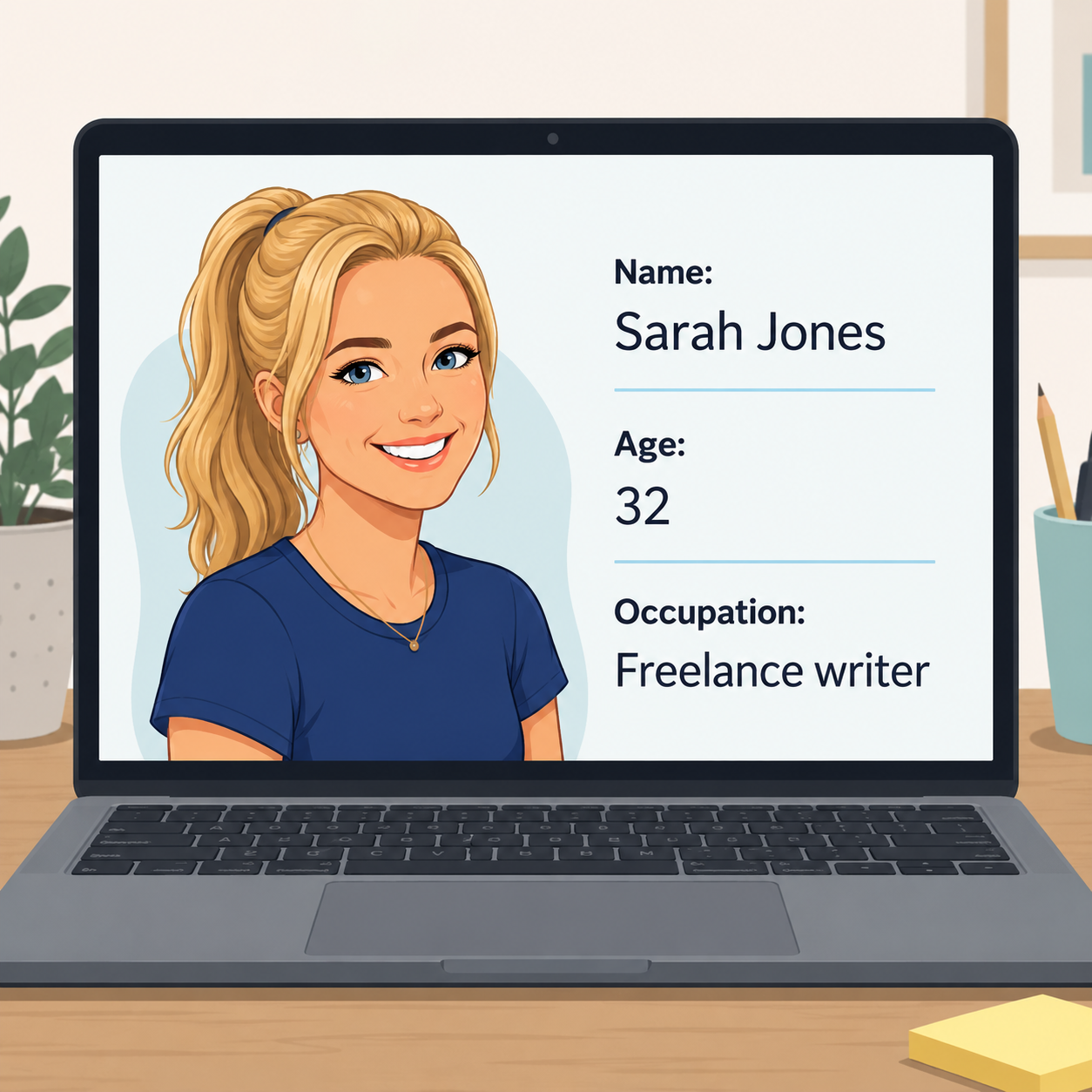
Image generated by ChatGPT
That’s what keeps coming back to me. It wasn’t the research that made those personas convincing—it was the detail. A name, an age, a pain point in her own words—that’s a costume that fits almost anything, even a guess.
It’s amazing how quickly an AI can whip up a persona—and dress it up better than I ever could. If you ask it for a caregiver persona, it instantly gives you demographics, a quote, a day in the life, and a frustration with current tools, all without the hesitation a person might show when unsure. It never even needs to chat with a real caregiver to do this. Unlike my old decks, where I at least sat in on a few interviews before adding details, the model doesn’t need any real contact to sound convincing.
Eric made a really important point I want to keep clear: he wasn’t saying AI shouldn’t touch personas at all. If you use real interviews and transcripts to build a persona you can ask follow-up questions of, you’re grounding AI in something true. What he cautioned against is taking the shortcut before doing the research—skipping real people and letting the model imagine them instead, ending up with something that looks like a finding but isn’t.
In marketing, a wrong persona might just mean a campaign underperforms; we’d tweak the budget and try again next quarter. In health tech, though, that invented persona could stand in for someone managing a diagnosis or a caregiver at 2 a.m. deciding whether a symptom needs a call. A guess dressed up as research doesn’t just waste time—it can create a workflow that quietly lets down the person it was meant to help, and no one might trace it back to the moment we didn’t talk to a real caregiver.
What stuck with me most from our chat was Eric’s vision for AI: not replacing people, but taking over the scheduling, recruiting, screening, and endless rebooking that drain a researcher’s week—the very stuff that makes teams skip real interviews. Let AI smooth out the bumps so we can have more human conversations, not fewer. He said it in a way I keep thinking about: he doesn’t want AI doing his art while he handles chores. He wants the reverse—AI on the chores so there’s more space for the part that truly needs sitting with someone and listening.
I see my old personas differently now. They weren’t just shortcuts in research; they were like costumes I got good at wearing, where confidence stood in for the real thing. The AI version is faster, sleeker, and ready for anyone, but it still lacks interviews. The giveaway is the same as always: a user who never surprises you, never challenges what you already think, never says something unexpected. A real person will do that eventually—that’s how you know you were really listening.
Listen to Eric’s Healthcare UX episode.