What MyChart Gets Wrong About Caregivers
Caregivers are usually doing this work on top of everything else in their lives — exhausted, under-slept, managing someone else's health while still running their own. When the tool meant to help them share information or get access is confusing, the cost isn't a bad app rating. It's one more thing standing between a caregiver and the person they're trying to look after.
I found that out firsthand last year, not as a designer, but as a patient. I was sick and wanted to share my MyChart account with my daughter so she could help me keep track of things. It should have been a five-minute task. Instead: confusing, cumbersome, and after several screens, an error message. No invite, no explanation, just a failure.
Once I'd recovered, I went back in as a designer and walked the flow again to see exactly where it broke. I presented the teardown live at a Houston IxDF meetup; here's the short version.
Where it breaks
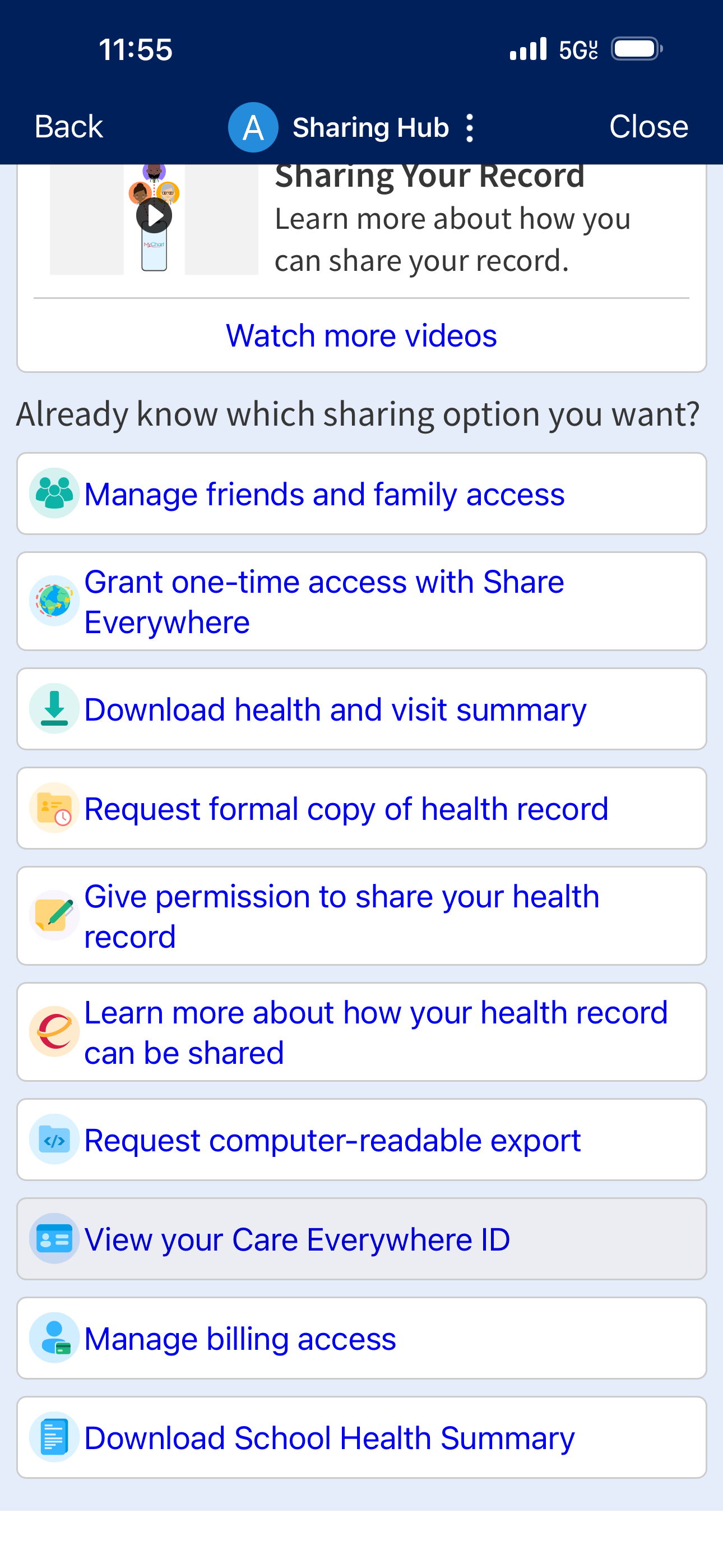
There's no clear path to "share my health information with someone." The option lives buried in the hamburger menu, under a "Sharing" section, next to unrelated items like Insurance Summary and Computer-Readable Export. Nothing signals "this is where you add a caregiver" — you find it by hunting.
Copyright MyChart/EPIC
Once you do find it, the app tries to cover every sharing scenario at once — yourself, a family member, a healthcare provider — each with paragraphs of explanation, plus separate instructions for requesting records from three different medical systems by phone, fax, or mail. Even after selecting "family member, close friend, or caretaker," you land in a list of ten different sharing options — Manage friends and family access, Grant one-time access, Download health and visit summary, and so on — and have to correctly interpret the difference before choosing. A task that should be one decision requires first becoming fluent in the app's own taxonomy.
And then, assuming you make it through: an error. "There was an error retrieving data from the server." No explanation, no retry, no way to tell whether the invite went through. I'd done everything the app asked, in order, and had nothing to show for it.
The fix
My redesign treats "invite a caregiver" as its own clear entry point instead of a use case buried inside a general sharing hub — splitting the menu into two plain options, Share Records and Invite a Caregiver. The invite itself collapses from four screens to one: name, email or phone, and tappable chips for exactly what to share — appointments, messages, test results, medications, billing, medical history. No definitions to parse, no confusion. Fill in two fields, tap what you want shared, send. On completion, a plain confirmation screen: "Invite has been sent to [name]," with no ambiguity about whether it worked.
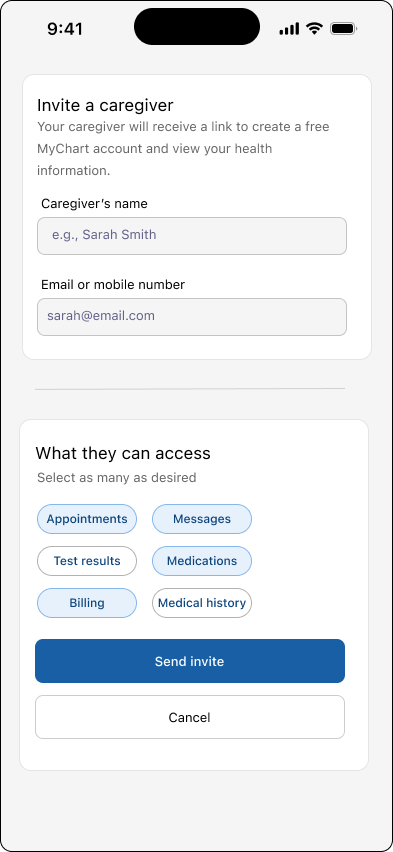
The principle behind every change was the same: reduce the number of decisions a caregiver has to make about the software before they can do the actual task.
A pattern I keep seeing
MyChart's sharing flow isn't confusing by accident — it's built to handle every institutional sharing scenario a health system needs (patients, providers, record requests, legal proxies), and the caregiver's task gets flattened into just one more branch of that structure. The interface reflects how the institution organizes information, not how the person in front of it is actually thinking. A caregiver isn't thinking in "sharing hub" categories. They're thinking, "I need my daughter to see this."
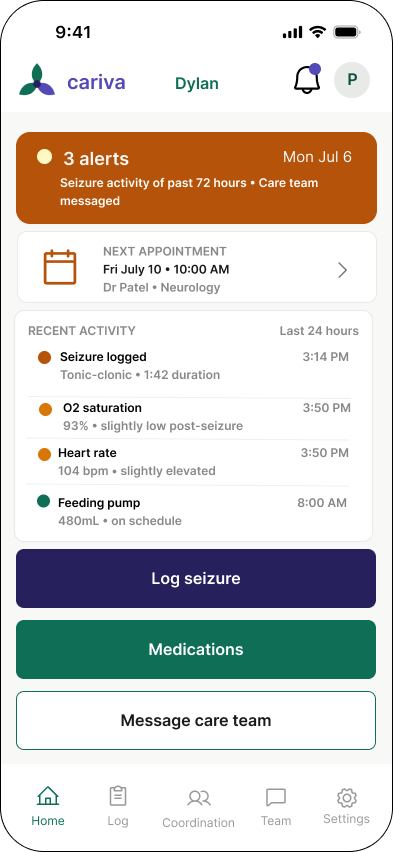
It's the same problem I designed against from the ground up with Cariva™. Rather than retrofitting a caregiver use case onto a system built for something else, Cariva™ starts from the caregiver's task itself — coordinating and tracking someone else's care — as the primary structure, not a branch off of it. Seeing the same institutional-logic-versus-lived-experience gap show up independently in a live audit of MyChart and in my own design decisions on Cariva™ is what convinced me this isn't a one-app problem. It's a default failure mode in healthcare software, and designing caregiver-first from the start — rather than bolting caregiver access onto a patient-first system — is the actual fix.